Moving Beyond Etsy and eBay: Why Your Own Website Saves You Money
If you started out selling on marketplaces like Etsy, eBay, or Vinted, you already know the appeal. They make it simple to set up a shop front and get your products in front of active buyers without needing any technical know-how.
When you are starting out, that built-in traffic is a lifesaver. But as your business grows, a familiar frustration creeps in. Between listing fees, transaction charges, final value cuts, and payment processing fees, a surprisingly large chunk of your hard-earned revenue quietly slips away.
I recently sat down with a local business client right here in County Durham who hit that exact crossroads. We walked through a quote for an independent e-commerce website and looked at how long it would take to see a return on investment. When she weighed up what she was paying out to third-party platforms—plus the frustration of having zero control over sudden rule changes—she decided to make the leap.
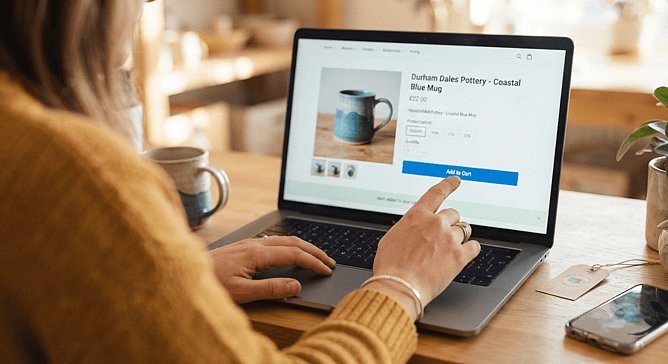
As it happens, her new e-commerce website has only been live for a week, and she has already made half of her initial investment back through direct sales.
Here is why investing in professional e-commerce web design and moving away from marketplaces often turns out to be much cheaper and more strategic in the long run.
1. The Hidden Cost of Marketplace Fees
Platforms like Etsy, eBay, and Vinted charge handsomely for the privilege of using their digital real estate.
You face listing fees, category insertion fees, final value fees calculated as a percentage of your total sale (including postage!), and payment processing cuts on top. Every time you make a sale, the platform takes its share before the money ever reaches your bank account.
While those small percentages are easy to ignore initially, they scale up aggressively as order volumes grow. On your own e-commerce website, you keep 100% of your sales revenue, minus standard, transparent payment gateway processing fees (like Stripe or PayPal) which are typically much lower than marketplace tolls.
2. Choosing the Right Platform for Your Inventory
When you build your own e-commerce website, picking a platform that matches the scale of your business matters. Size really does count.
For smaller inventories: Platforms like Rocketspark are brilliant. They offer a clean, user-friendly setup that handles everyday e-commerce capabilities with ease, keeping day-to-day management straightforward and stress-free.
For large inventories: If you manage hundreds of products with complex variables—such as extensive sizing, custom options, or intricate product variations—you will need a platform built for heavy lifting. In those instances, a robust option like BigCommerce is often the smarter route as you scale.
3. Owning Your Customers and Your Control
When someone buys from you on a marketplace, they are technically their customer, not yours. You have limited ability to build a direct relationship, retarget them for future purchases, or build an email subscriber list. More importantly, you are entirely at the mercy of third-party policies and algorithm changes.
On your own custom website, you hold the reins. You own the entire customer journey, capture email addresses, run targeted loyalty campaigns, and create a branded unboxing experience that keeps people coming back directly to you.
Making the Leap
Moving away from marketplaces can feel daunting if you are used to relying on their traffic. But taking control of your e-commerce setup is one of the most empowering milestones for a growing business—and it is often much more affordable than business owners initially think.
By looking past the initial setup investment and examining your long-term outgoings, marketplace fees usually cost far more than you realise. If you are a business owner around Consett, County Durham, or the wider North East region, and you are tired of watching third-party platforms eat into your profit margins, get in touch with us to explore our custom e-commerce web design services.